Mod Core Deluxe MKII
Shape your tone with advanced routing. Modify your tone with Modulation
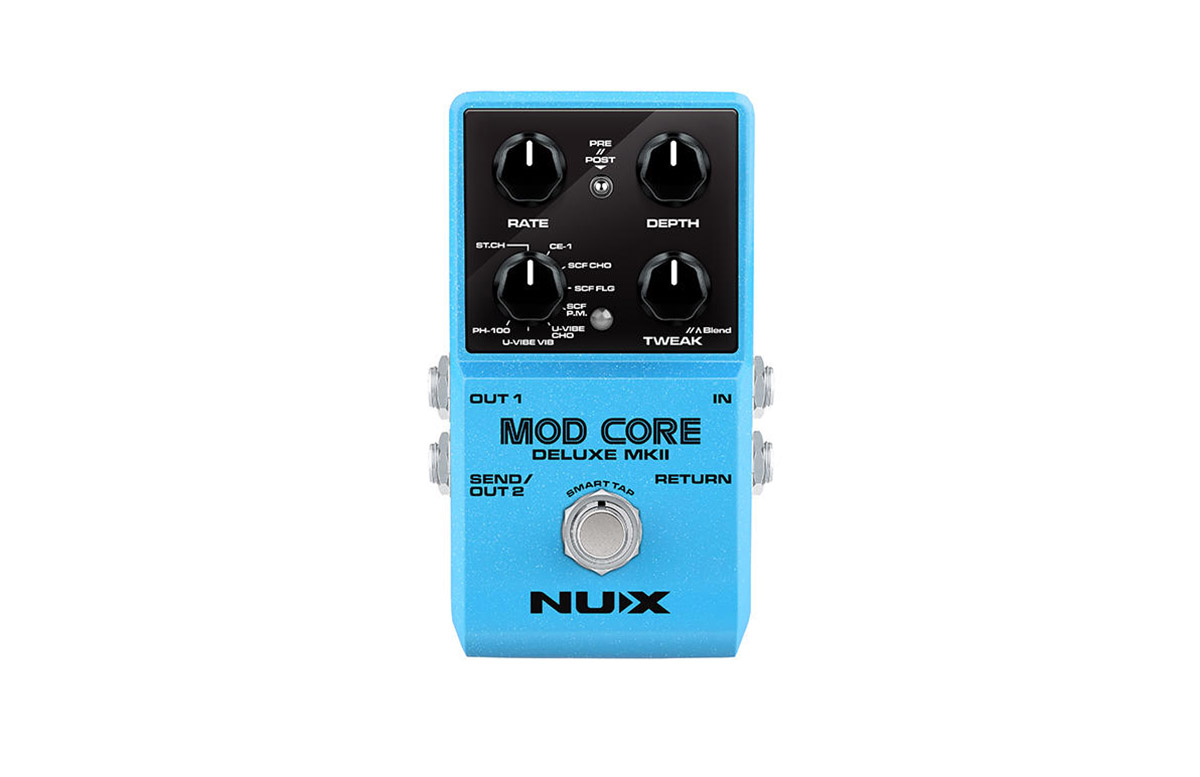
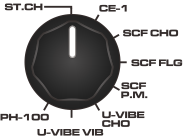
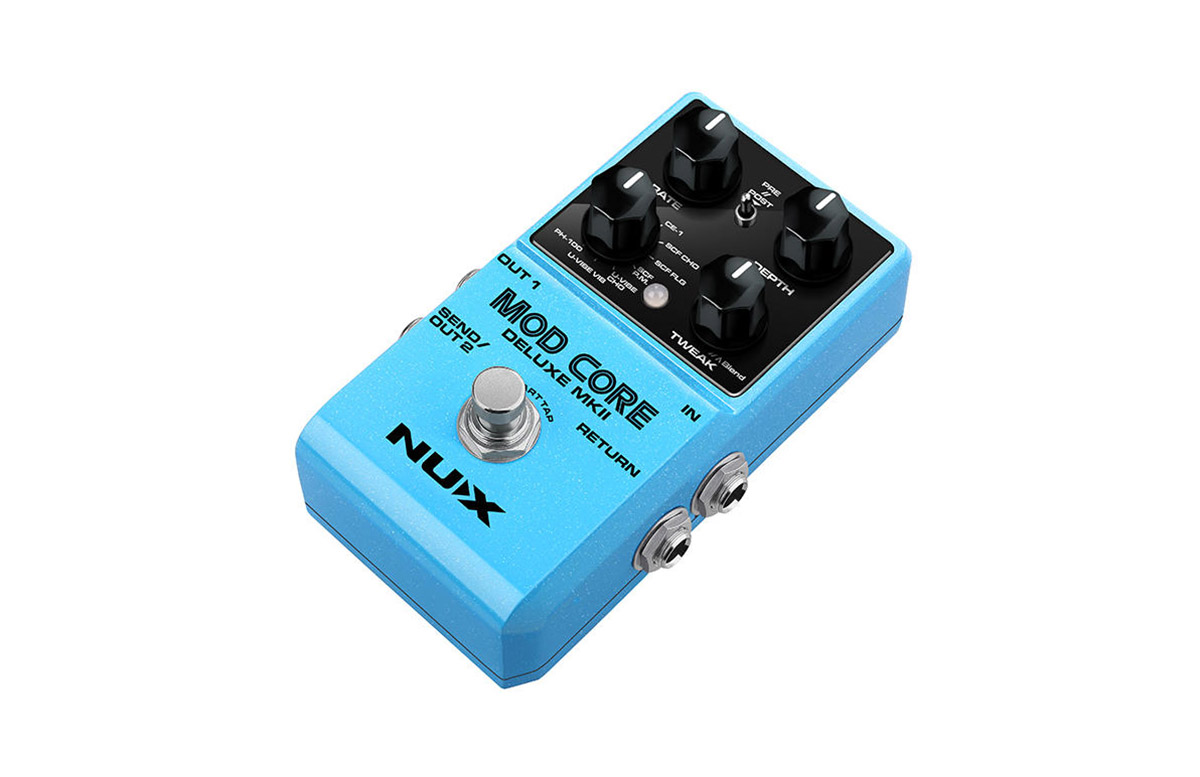
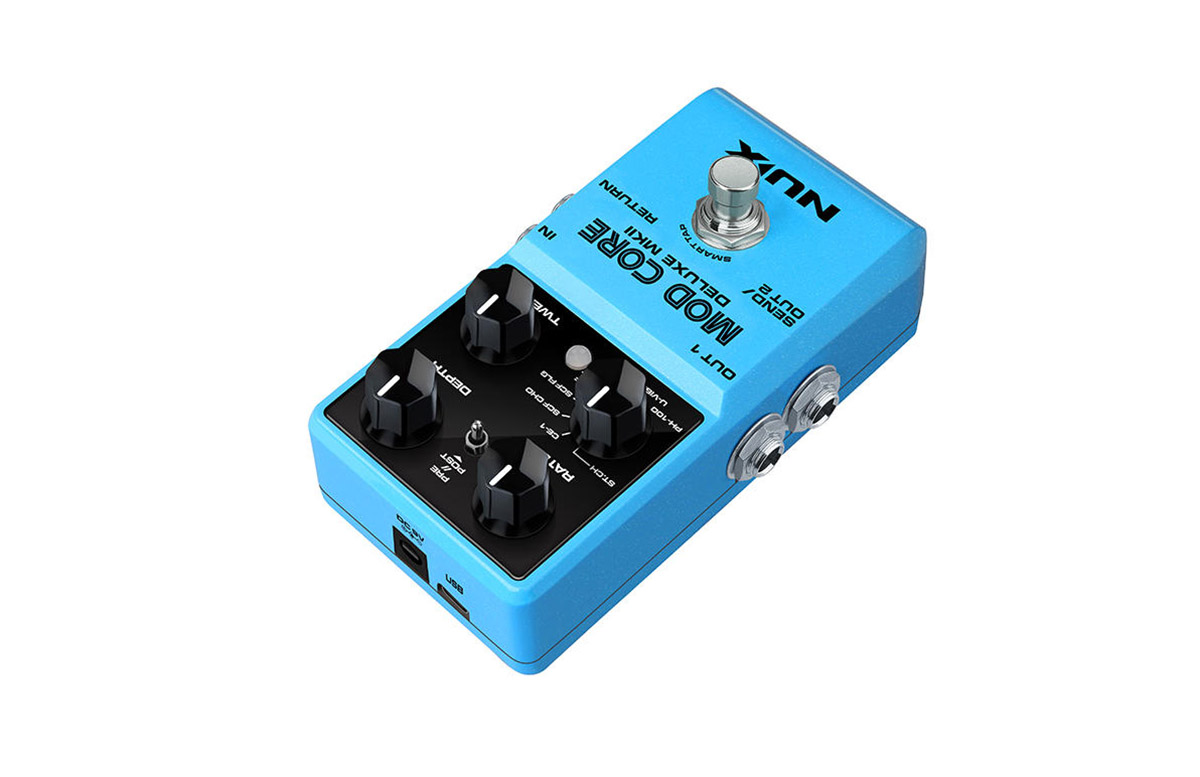
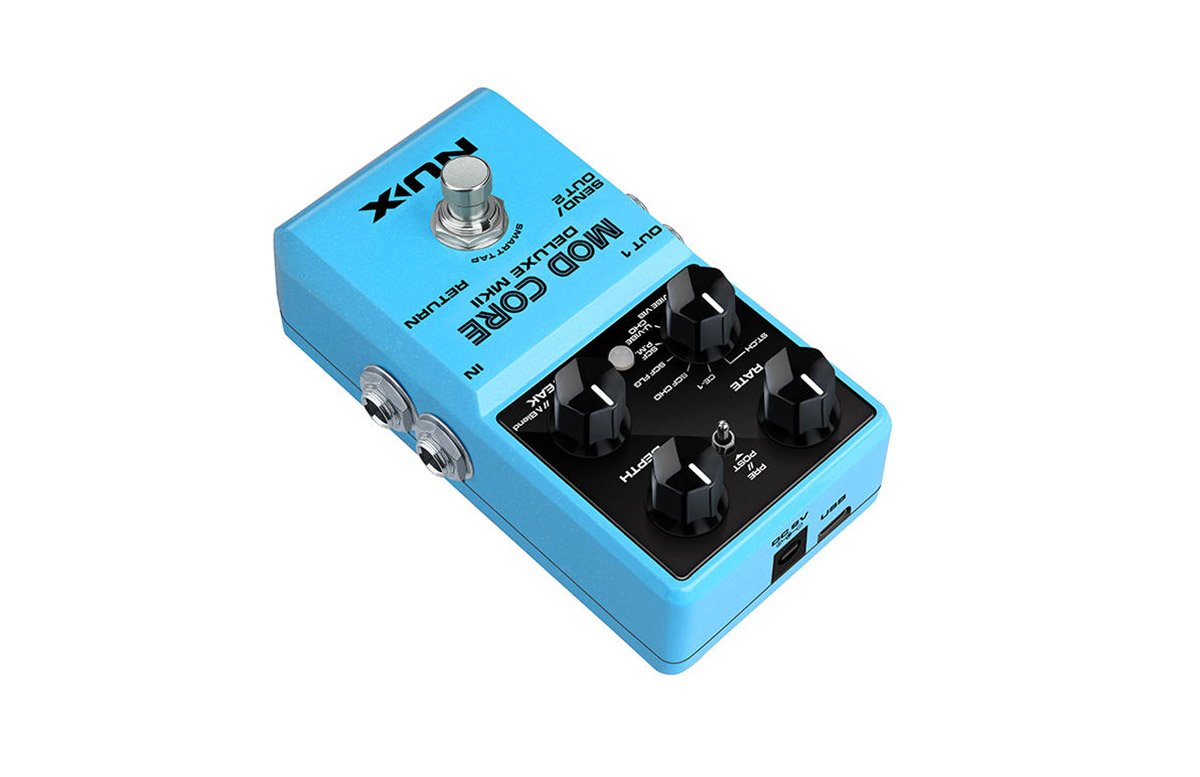
The NUX MOD CORE DELUXE MKII is a modulation pedal featuring 8 different modulation types: ST.CH (Stereo Chorus), CE-1, SCF CHO, SCF FLG, SCF P.M., U-VIBE CHO, U-VIBE VIB, and PH-100. You can switch between modulation types using the Type rotary switch.
This pedal also offers advanced signal routing via the Send and Return jacks. Easily split the mono signal to create customized effects loops. You can also run the two signals in parallel and use the Tweak knob in Alt mode to blend them.
Use the 3-way toggle switch to select the desired routing position, and you’re ready to go. Keep reading below for more signal-routing ideas.
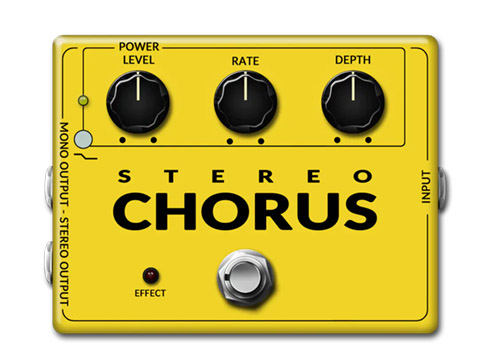
ST.CH (Stereo Chorus) is inspired by the MXR® Stereo Chorus, which is beautifully voiced. We’ve consolidated the controls by eliminating the Bass and Treble knobs, which are now internally set to their middle positions. We’ve also eliminated the need for the Bass Filter, which is now automatically compensated for through the advancements of Core-Image™ sound modeling.
CE-1 is based on the legendary BOSS® CE-1, the first chorus effect pedal introduced in 1976. Before that, the effect was only available as a built-in feature on a classic jazz amplifier.
The MOD CORE DELUXE MKII faithfully replicates the characteristics of this iconic pedal, delivering its distinctive warmth and rich, jazz-inspired character—an instantly recognizable enhancement to any musician’s tone.
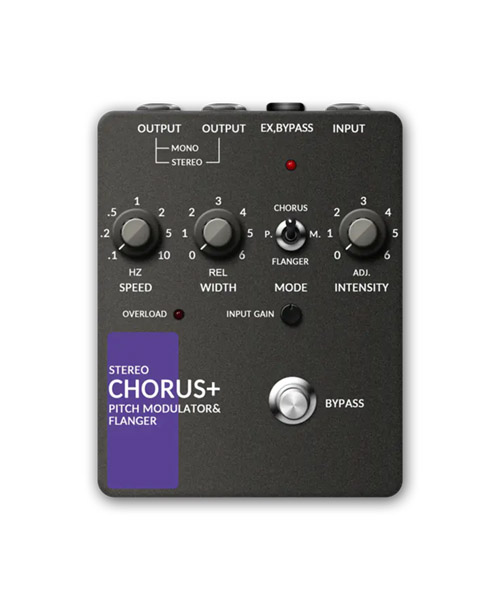
SCF is a tribute to the TC Electronic® Stereo Chorus Flanger, widely regarded as one of the finest modulation pedals ever made.
SCF CHO: A chorus effect is essentially created by mixing multiple pitch-modulated delay signals with the original signal, producing a smooth, spacious, and wide modulation effect.
SCF FLG: A flanger works on a similar principle to chorus, but the delayed signal is fed back into the effect, creating a more pronounced and distinctive modulation sound.
SCF P.M.: A combination of chorus and pitch vibrato that creates a lighter, more subtle chorus effect.

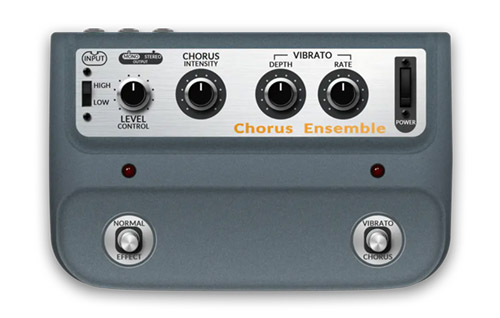
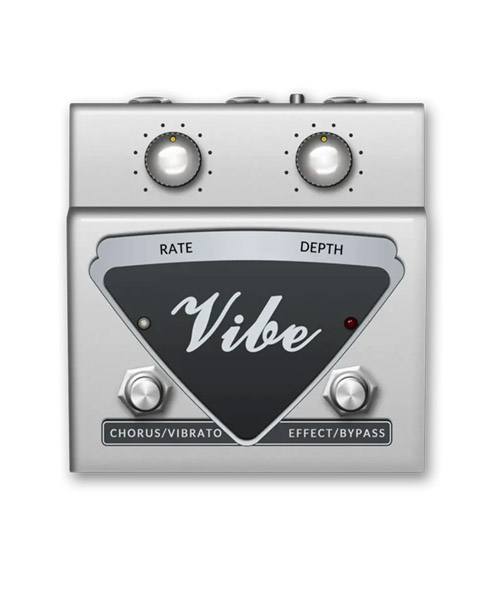
U-VIBE is inspired by the Dunlop® Uni-Vibe®, renowned for its distinctive and unforgettable sound. The original Uni-Vibe produced a rich, three-dimensional modulation effect by recreating the character of a rotating speaker, a sound famously associated with Jimi Hendrix’s iconic performances in the 1960s.
U-VIBE CHO: The Depth knob adjusts the intensity of the sweeping modulation effect.
U-VIBE VIB: The Depth knob adjusts the amount of pitch modulation.
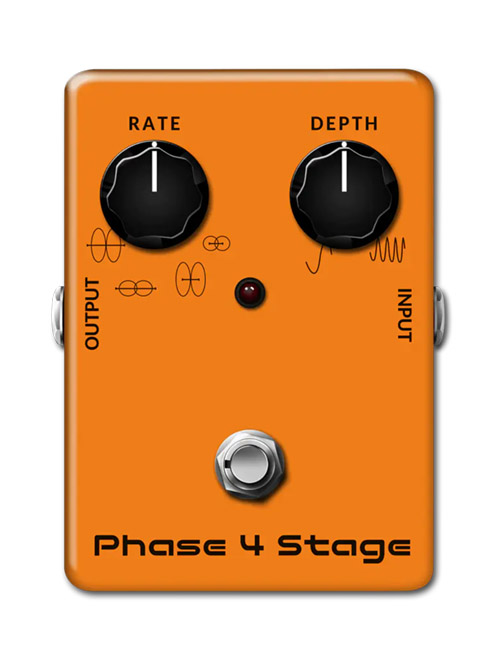
PH-100 is based on the MXR® PHASE 100 which has both a Speed control and a 4-waveform Intensity control, the Phase 100 offers a broad range of tones.
*All the brand and model names mentioned on this page are Trademarks of their respective owners, which are in no way associated or affiliated with NUX Effects and Cherub Technology CO. LTD
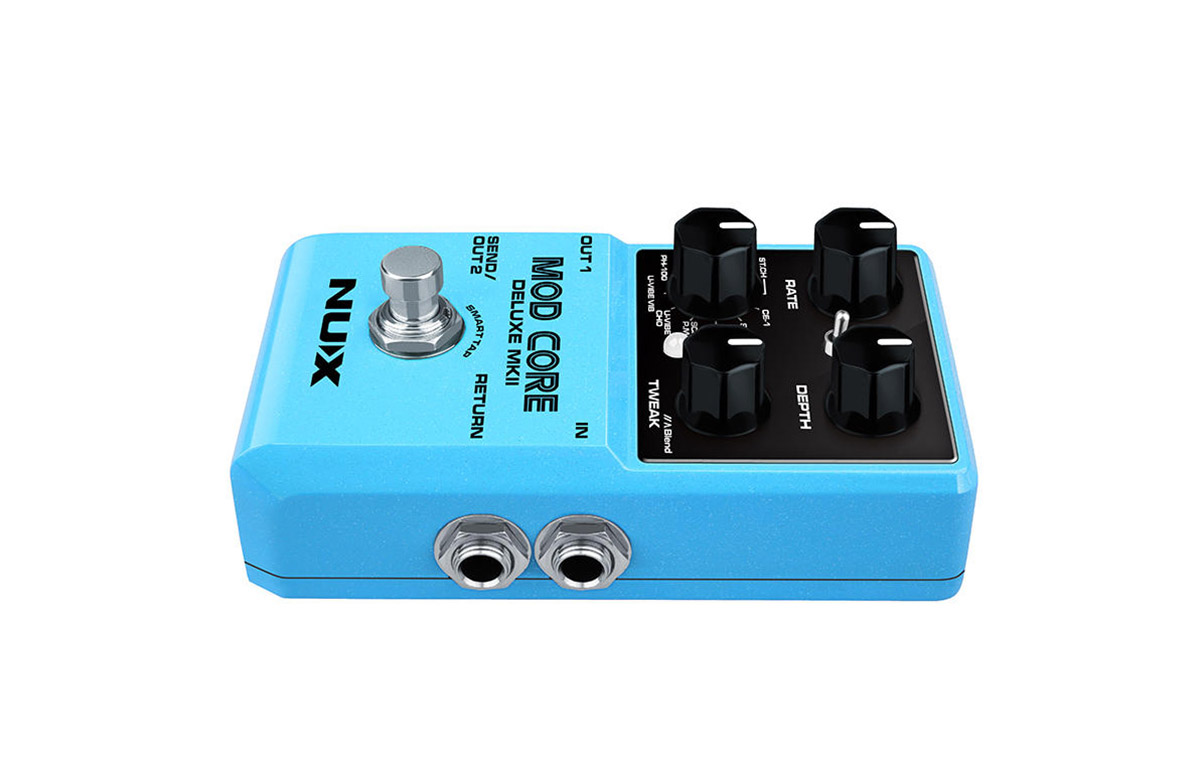
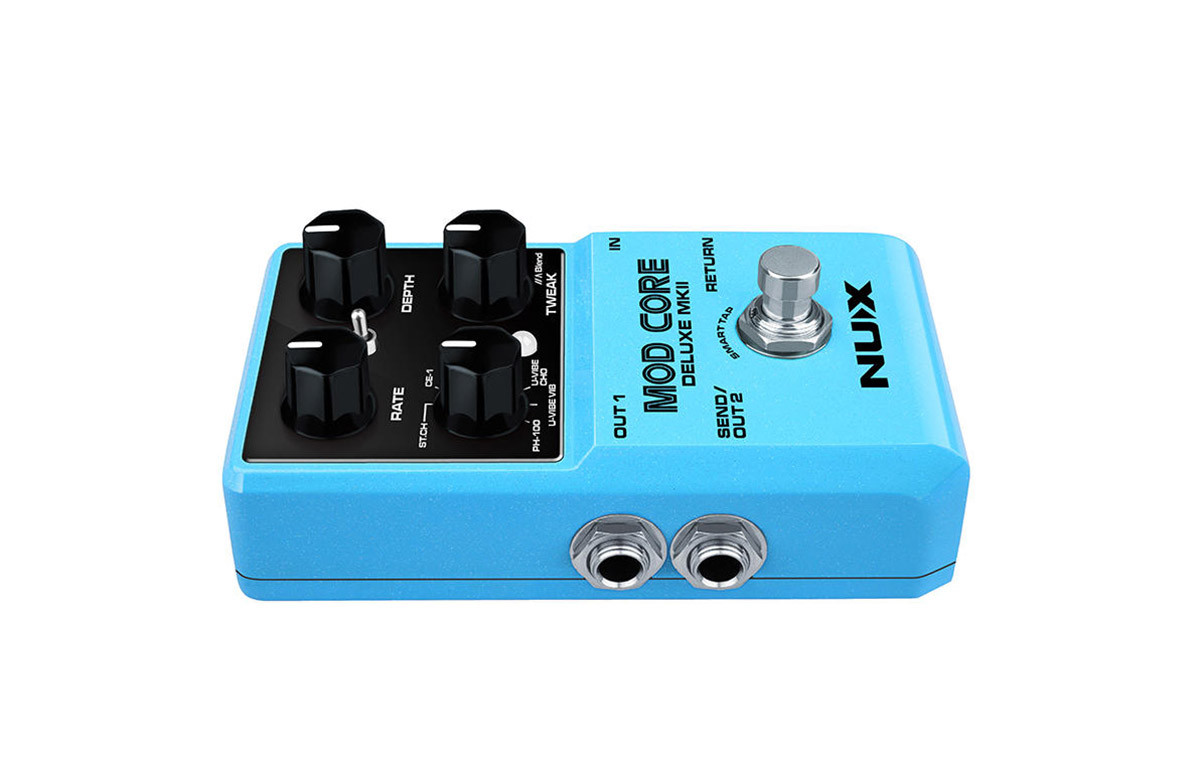
An Intuitive User Interface
RATE knob
Adjusts the delay time. Set the knob to your desired subdivision, then use Smart Tap Tempo to set the delay time according to the tap tempo.
Delay time range for each model:
- Φ Phi Digital Delay: 80 ms–1000 ms
- Analog Delay: 40 ms–403 ms
- Modulation Delay: 20 ms–1500 ms
- Tape Echo: 55 ms–552 ms
- Pan Delay: 80 ms–1000 ms
- Verb Delay: 80 ms–1000 ms
- Reverse Delay: 320 ms–1240 ms
Note: The maximum delay time available via Smart Tap Tempo is 1580 ms.
DEPTH knob
Modulation Type knob
Selects the type of delay.
TWEAK knob
Toggle switch
Set the toggle switch to the desired position to select the signal routing.
- PRE: The modulation effect is placed before the Send/Return loop.
- // (Parallel): The modulation effect and the Send/Return loop are routed in parallel.
- POST: The modulation effect is placed after the Send/Return loop.
Footswitch & FS Indicator
Press once to engage or disengage the effect. Press twice to activate Smart Tap Tempo. The delay time is determined by the tap tempo and the current subdivision setting. The FS indicator will flash in sync with the current BPM.
Note: The maximum delay time when using Tap Tempo is 1,580 ms.
When the effect is engaged, the FS indicator will light red. When the effect is disengaged, the FS indicator will turn off.
I/O Jacks
DC Jack
Use only a 9V DC, center-negative power supply rated at 150 mA or higher. The power consumption is less than 110 mA.
USB-C Port
The USB-C port is used for firmware updates. Connect the device to your computer with a USB cable, then hold the footswitch while powering on the device to enter DFU (Device Firmware Update) mode.
Once connected, you can update the firmware using the DFU updater software.
Download the latest firmware and firmware update guide from the product page.
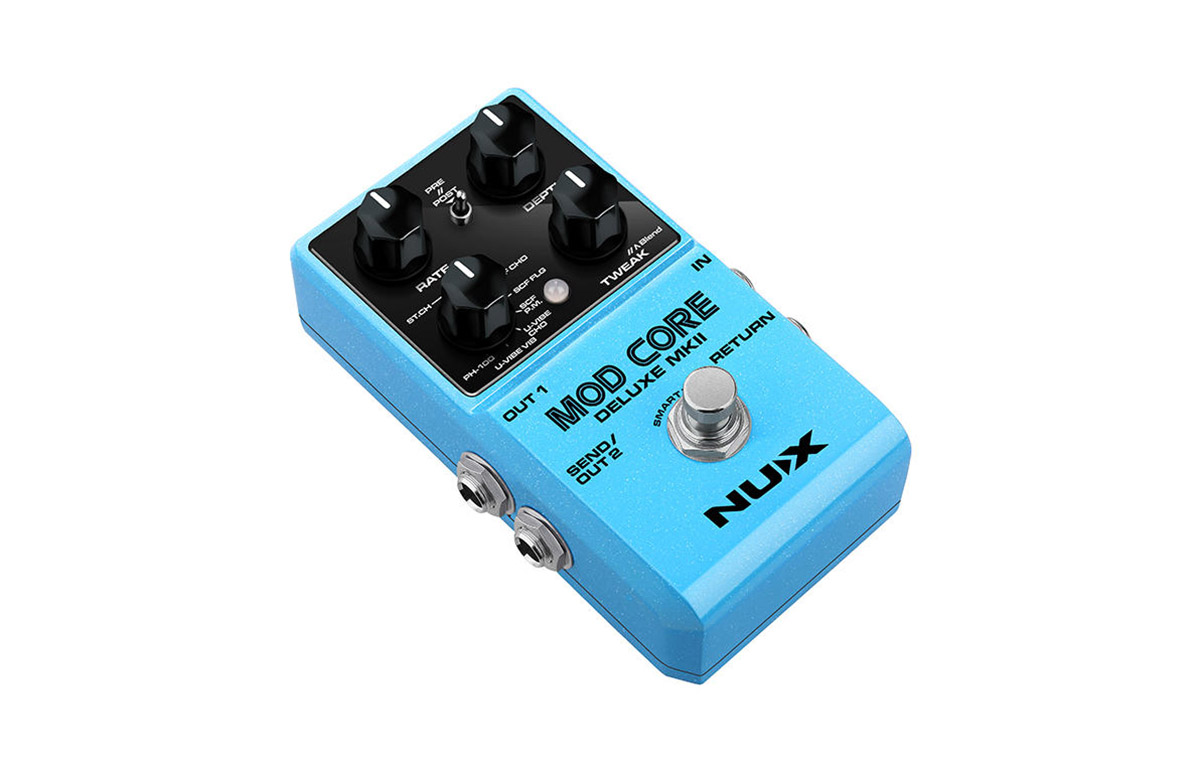
Input Jack
The audio input on the right side of the pedal is a standard 1/4″ mono (TS) jack. Connect your guitar to the IN jack using a standard 1/4″ instrument cable.
Return Jack
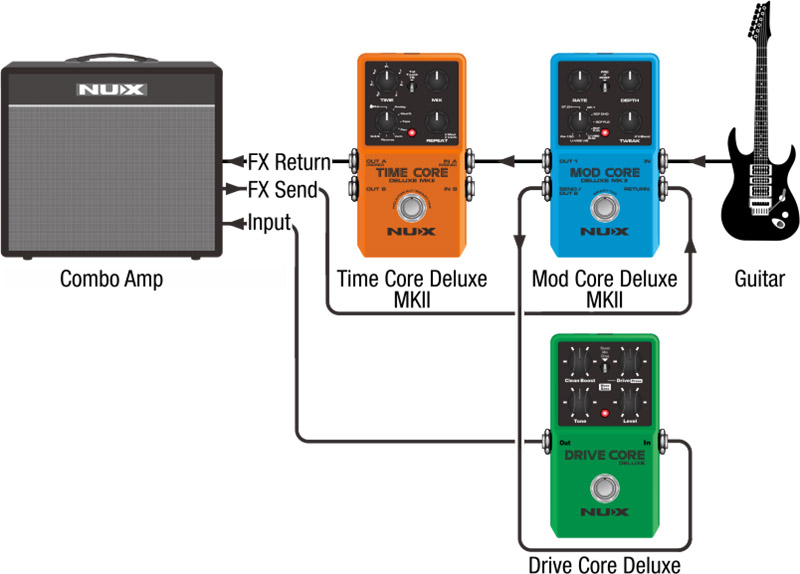
In advanced routing mode, connect the output of a pre-effect, such as an overdrive or distortion pedal, to the RETURN jack.
Output Jacks
Normal Routing:
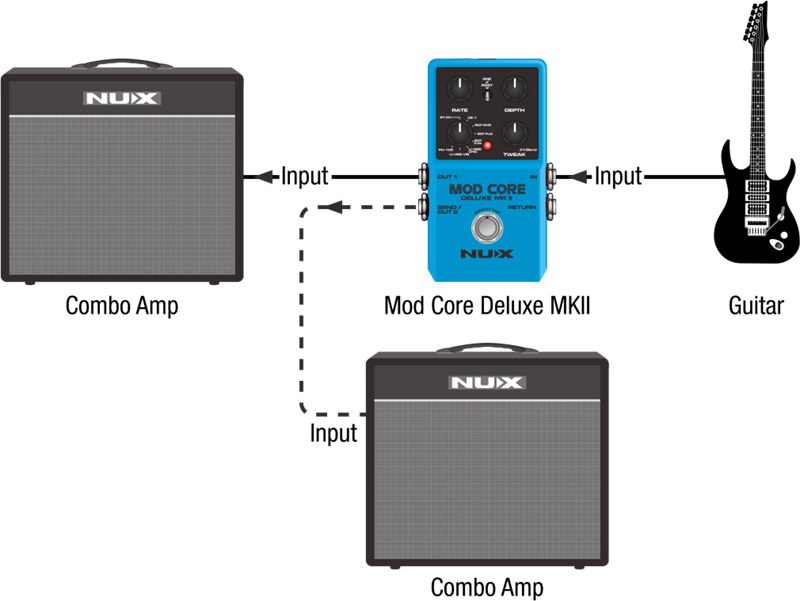
The audio outputs on the left side of the pedal are standard 1/4″ mono (TS) jacks. Connect OUT 1 to the next device in the signal chain using a single 1/4″ cable, or use both OUT 1 and OUT 2 for two-output operation.
Advanced Routing:
OUT 1 carries the modulation-effect signal, while SEND carries the effects-loop signal.
Connections
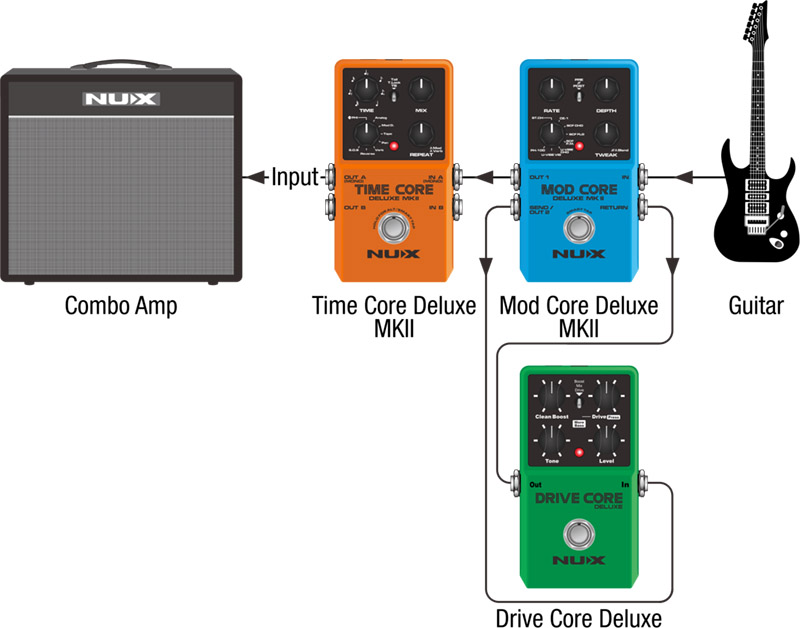
1. Normal routing: (In this connection, the toggle switch has no function.)
To the amp’s input.
2. Advanced Routing: You can select PRE, // (PARALLEL), or POST using the toggle switch.
In line.
In the amp’s FX loop.
– 8 modulation types in a compact enclosure.
– ST.CH (Stereo Chorus), CE-1, SCF CHO, SCF FLG, SCF P.M., U-VIBE CHO, U-VIBE VIB, and PH-100.
– ST.CH is based on MXR® Stereo Chorus.
– CE-1 is based on BOSS® CE-1.
– SCF is based on TC Electronic® SCF Stereo Chorus Flanger.
– U-VIBE is based on Dunlop® UV-1 Uni-Vibe Chorus/Vibrato.
– PH-100 is based on MXR® Phase 100.
– Normal routing (mono or stereo output) and advanced routing (PRE, //, POST).
– Parallel routing offers a Blend parameter. (In Alt mode, the Tweak knob becomes the Blend parameter.)
– Smart Tap Tempo (50–200 BPM).
– Low power consumption (less than 120 mA).
– Analog dry signal for low noise and zero latency.
– Input Impedance: 1 MΩ
– Output Impedance: 1 kΩ
– Dynamic Range: 104 dB
– DSP Processing: 48 kHz / 32-bit
– A/D and D/A Sampling Rate: 48 kHz / 24-bit
– Power: 9 V DC (negative tip, optional ACD-006A adapter)
– Current Draw: Less than 120 mA
– Dimensions: 122 (L) × 72 (W) × 47 (H) mm